Were There Art and Literature Reformations During the Second Great Awakening
The 2d Swell Awakening
The Second Corking Awakening, which spread organized religion through revivals and emotional preaching, sparked a number of reform movements.
Learning Objectives
Summarize the cardinal commitments and effects of the Second Great Awakening
Key Takeaways
Key Points
- The Second Great Awakening was a Protestant revival motion during the early nineteenth century. The movement started around 1800, had begun to gain momentum by 1820, and was in pass up by 1870.
- Revivals were a key part of the motility and attracted hundreds of converts to new Protestant denominations.
- The Methodist Church used circuit riders to reach people in frontier locations.
- The Second Great Awakening led to a catamenia of antebellum social reform and an emphasis on salvation past institutions.
Key Terms
- Methodists: A motion of Protestant Christianity represented past a number of denominations and organizations, claiming a full of approximately lxx meg adherents worldwide; the movement traces its roots to John Wesley's evangelistic revival movement within Anglicanism.
- Baptist: Of or relating to a Protestant denomination of Christianity, which believes in the baptism of believers equally opposed to the baptism of infants.
- Arminian: Of or relating to the religious philosophy founded past the Dutch theologian Jacobus Arminius.
Introduction
The Second Smashing Awakening was a Protestant revival motility during the early nineteenth century. The movement began around 1790 and gained momentum by 1800; after 1820, membership rose quickly among Baptist and Methodist congregations, whose preachers led the movement. The Second Not bad Awakening began to refuse by 1870. Information technology enrolled millions of new members and led to the formation of new denominations. Information technology has been described as a reaction against skepticism, deism, and rational Christianity, although why those forces became pressing plenty at the fourth dimension to spark revivals is not fully understood.
The Second Great Awakening expressed Arminian theology, by which every person could be saved through revivals, repentance, and conversion. Revivals were mass religious meetings featuring emotional preaching by evangelists such every bit the eccentric Lorenzo Dow. Many converts believed that the Enkindling heralded a new millennial age. The Second Swell Awakening stimulated the establishment of many reform movements designed to remedy the evils of society before the Second Coming of Jesus Christ.

Lorenzo Dow, American itinerant preacher: The Second Great Awakening included large revivals, which were passionate meetings led by evangelist preachers such equally the eccentric Lorenzo Dow.
The 2nd Not bad Awakening had a profound upshot on American religious history. The numerical strength of the Baptists and Methodists rose relative to that of the denominations dominant in the colonial flow, such as the Anglicans, Presbyterians, Congregationalists, and Reformed.
Background
The outburst of religious enthusiasm that began in Kentucky and Tennessee in the 1790s and early 1800s amidst Baptists, Methodists, and Presbyterians owed much to the uniqueness of the early decades of the democracy. These years saw swift population growth, broad western expansion, and the rise of participatory democracy. These political and social changes made many people anxious, and the more egalitarian, emotional, and individualistic religious practices of the Second Great Enkindling provided relief and comfort for Americans experiencing rapid change. The awakening soon spread to the Due east, where information technology had a profound issue on Congregationalists and Presbyterians. The thousands swept up in the movement believed in the possibility of creating a much meliorate earth. Many adopted millennialism, the fervent belief that the Kingdom of God would exist established on earth and that God would reign on world for a 1000 years, characterized by harmony and Christian morality. Those drawn to the message of the 2nd Great Awakening yearned for stability, decency, and goodness in the new and turbulent American democracy.
Evangelizing the Frontiers
Congregationalists fix missionary societies to evangelize the western territory of the Northern Tier. Members of these groups acted as apostles for the faith, educators, and exponents of northeastern urban culture. The Second Neat Awakening served as an organizing process that created, "a religious and educational infrastructure" across the western borderland that encompassed social networks, a religious journalism that provided mass communication, and church building-related colleges. Publication and education societies promoted Christian didactics; most notable amidst them was the American Bible Guild, founded in 1816.
Women fabricated up a large role of these voluntary societies. The Female Missionary Society and the Maternal Association, both active in Utica, New York, were highly organized and financially sophisticated women's organizations responsible for many of the evangelical converts of the New York frontier.
Each denomination that participated in the Second Bang-up Awakening had assets that allowed it to thrive on the borderland. The Methodists had an efficient arrangement that depended on ministers known as "circuit riders," who sought out people in remote frontier locations. The circuit riders came from among the common people, which helped them establish rapport with the frontier families they hoped to convert.
Relation to Social Reform
Social reform prior to the Civil War came largely out of this new devotion to religion. Efforts to apply Christian teaching to the resolution of social problems presaged the social gospel of the belatedly nineteenth century. Converts were taught that to achieve salvation, they needed not just to repent for personal sin but too work for the moral perfection of order, which meant eradicating sin in all its forms. Thus, evangelical converts were leading figures in a diverseness of nineteenth-century reform movements.
Reforms took the shape of social movements for temperance, women'south rights, and the abolitionism of slavery. Social activists began efforts to reform prisons and care for the handicapped and mentally ill. They believed in the perfectibility of people and were highly moralistic in their endeavors. Many participants in the revival meetings believed that reform was a office of God's plan. As a result, local churches saw their role in society every bit purifying the earth through the individuals to whom they could bring salvation, as well as through changes in the law and the creation of institutions. Interest in transforming the globe was applied to political activeness, as temperance activists, antislavery advocates, and proponents of other variations of reform sought to implement their behavior into national politics. While religion had previously played an important role on the American political scene, the Second Great Awakening highlighted the important role which private beliefs would play.
Unitarianism and Universalism
Unitarianism and Universalism were early Christian denominations that spread quickly during the nineteenth century.
Learning Objectives
Hash out the central commitments and development of Unitarianism and Universalism in the U.s.
Key Takeaways
Key Points
- Unitarianism is a Christian theological movement named for its understanding of God as one person, in direct contrast to Trinitarianism, which defines God as three persons coexisting consubstantially every bit one in beingness.
- Unitarianism spread quickly through New England beginning in the mid-eighteenth century and was particularly influential in the theology of the Harvard Divinity School in the nineteenth century.
- The Universalist Church building of America held that all human being beings may be saved through Jesus Christ and would come to harmony in God'due south kingdom.
- Universalism emerged in the late eighteenth century from a mixture of Anabaptists, Moravians, liberal Quakers, and people influenced by Pietist movements such every bit Methodism.
Key Terms
- monotheism: The conventionalities in a single god (i God), especially within an organized organized religion.
- Unitarianism: A Christian theological movement, named for its agreement of God as one person, in direct contrast to the belief of God equally three persons coexisting consubstantially as one in being.
- Universalism: In Christianity, the belief that all humans may exist saved through Jesus Christ and eventually volition come to harmony in God'due south kingdom.
Unitarianism
Unitarianism is a Christian theological movement named for its understanding of God as ane person (in straight contrast to Trinitarianism, which defines God as three persons circumstantial equally 1 in being). Thus, Unitarians adhere to strict monotheism, maintaining that Jesus was a cracking human being and a prophet of God merely not God himself. Unitarianism began in Poland and Transylvania in the late sixteenth century and had reached England past the mid-seventeenth century.
Equally early equally the middle of the eighteenth century, a number of clergymen in New England preached what was essentially Unitarianism. The most prominent of these men was Jonathan Mayhew (1720–1766), pastor of the W Church in Boston, who preached the strict unity of God, the subordinate nature of Christ, and conservancy by character. Charles Chauncy (1705–1787), pastor of the Get-go Church from 1727 until his death, was both a Unitarian and a Universalist.
The first official acceptance of the Unitarian organized religion on the role of a congregation was by King's Chapel in Boston, which revised the prayer volume into a mild Unitarian liturgy in 1785. From 1725 to 1825, Unitarianism gained ground in New England and other areas. Beginning in 1805, Unitarian books appeared by John Sherman and Noah Worcester. At the offset of the nineteenth century, with one exception, all of the churches of Boston were occupied by Unitarian preachers, and various periodicals and organizations expressed Unitarian opinions. Churches were established in New York, Baltimore, Washington, Charleston, and elsewhere during this catamenia.
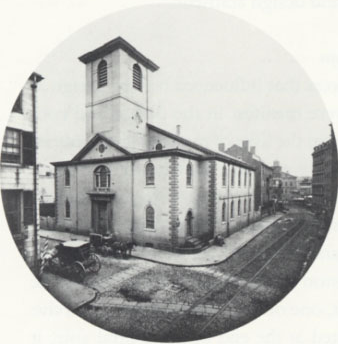
The Brattle Street Church in Boston, ca. 1859: Boston was the center of Unitarian action in America, and the Brattle Street Church was a prominent Unitarian venue.
The menstruum of American Unitarianism from about 1800 to 1835 can exist thought of as determinative, mainly influenced by English philosophy, semi-supernatural, imperfectly rationalistic, and devoted to philanthropy and applied Christianity. In 1800, Joseph Stevens Buckminster became minister of the Brattle Street Church in Boston, where his sermons and literary activities helped shape the subsequent growth of Unitarianism in New England. Unitarian Henry Ware was appointed as the Hollis professor of divinity at Harvard College in 1805, and Harvard Divinity school then shifted from its conservative roots to teach Unitarian theology.
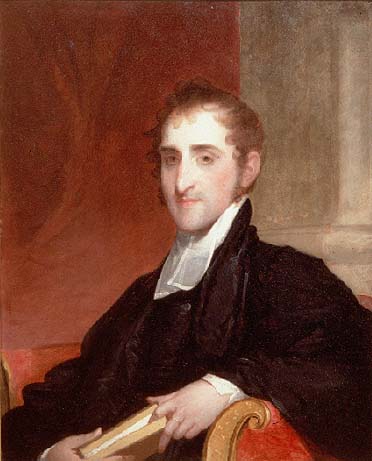
Rev. Joseph Stevens Buckminster, influential Unitarian preacher: Joseph Buckminster's preaching and texts greatly influenced American Unitarian idea.
Buckminster'due south close associate William Ellery Channing became the leader of the Unitarian movement. At commencement mystical rather than rationalist in his theology, he took role with the "Cosmic Christians," as they called themselves, who aimed at bringing Christianity into harmony with the progressive spirit of the time. His essays, "The System of Exclusion and Denunciation in Religion" (1815) and "Objections to Unitarian Christianity Considered" (1819) made him a defender of Unitarianism.
The result of the "Unitarian Controversy" in 1815 was a growing division in the Congregational churches, which was emphasized in 1825 by the formation of the American Unitarian Association at Boston. The association published books, supported poor churches, sent out missionaries, and established new churches in nearly every country.
Universalism
The Universalist Church of America, which held that all human being beings may exist saved through Jesus Christ and would come to harmony in God'south kingdom, emerged in the belatedly eighteenth century from a mixture of Anabaptists, Moravians, liberal Quakers, and people influenced past Pietist movements such every bit Methodism. Americans from these religious backgrounds gradually created a new denominational tradition of Christian Universalism during the nineteenth century. The Universalist Church of America grew to be the 6th-largest denomination in the Usa at its peak.
John Murray, who is called the "Father of American Universalism," was a central figure in the founding of the Universalist Church of America in 1793. He served as pastor of the Universalist Guild of Boston and wrote many hymns. Another important figure in early American Christian Universalism was George de Benneville, a French Huguenot preacher and physician who was imprisoned for advocating Universalism and later emigrated to Pennsylvania, where he connected preaching on the subject. Noted for his friendly and respectful relationship with American Indians and his pluralistic and multicultural view of spiritual truth, George de Benneville was well ahead of his time.
Other significant early modern Christian Universalist leaders included Elhanan Winchester, a Baptist preacher who wrote several books promoting the universal salvation of all souls after a period in purgatory and founded a church that ministered to African-American slaves in South Carolina; Hosea Ballou, a Universalist preacher in New England; and Hannah Whitall Smith, a writer and evangelist from a Quaker groundwork who was agile in the women'southward suffrage and temperance movements.
Women and Church Governance
Women constituted the majority of converts and participants in the Second Great Awakening and played an important informal role in religious revivals.
Learning Objectives
Assess the office of women in the religious revivals of the eighteenth and nineteenth centuries
Primal Takeaways
Key Points
- During the antebellum period, the Second Great Awakening inspired advancement for a number of reform topics, including women's rights.
- While they constituted the bulk of converts and participants, women were not formally indoctrinated and did non hold leading ministerial positions.
- Women did, however, become very important informally, as they facilitated conversion and religious upbringing of their children. Women ordinarily acted in their "condition quo" duties, didactics the virtues of motherhood and domesticity.
- To appeal to this women'due south movement, sermons often "feminized" Christ.
Key Terms
- antebellum reform: Societal changes undertaken by American Christians in the late 1800s, including in the temperance, women's-rights, and abolitionism movements.
Women and the Second Bully Awakening
Women made up the majority of the converts during the Second Bully Awakening and therefore played a crucial role in its evolution and focus. It is not clear why women converted in larger numbers than men. Several scholarly theories attribute the large number of conversions in part to women's assumption of greater religiosity. Conversion allowed women to shape identities and class community in a time of economic and personal insecurity and to assert themselves fifty-fifty in the face up of male person disapproval. Conversion may even have served equally a reaction to the perceived sinfulness of youthful frivolity. Some women, specially in the South, encountered opposition to their conversion from their husbands and had to choose between submission to God or to the head of the household. While in that location is no unmarried reason women joined the revival movement, the revival provided many women with shared experiences. Church membership and religious activity gave women peer back up and a place for meaningful activeness exterior of the dwelling.
Breezy Leadership
While they constituted the bulk of converts and participants, women were not formally indoctrinated and did not hold leading ministerial positions. They did occasionally take on public roles during revivals. They preached or prayed aloud on rare occasions, only they were more than probable to give testimonials of their conversion experience or work through the conversion process directly with sinners (who could exist male or female). Women's prayer was seen by leaders such as Charles Finney as a crucial aspect in preparing a customs for revival and improving the revival's efficacy.

Charles Grandison Finney, evangelist preacher: During the 2nd Swell Awakening, progressively minded western evangelists, led by Charles Finney, challenged the establishment'southward restrictions on women's participation in the church.
Though they typically held no formal leadership roles, women became very important informally in the procedure of conversion and in the religious upbringing of their children through family unit structure and through their maternal roles. During the period of the revivals, mothers—who were seen as the moral and spiritual foundation of the family—used their pedagogy and influence to laissez passer religion to their children.
The ascension number of women congregants influenced the doctrine preached past ministers as well. In an effort to give sermons that would resonate with the congregation, Christ was gradually "feminized" in this period to stress his humility and forgiveness.
Early on Organizing
Despite the influential part they played in the 2d Great Enkindling, these women nonetheless largely acted within their "status quo" roles every bit mothers and wives. The change in women'southward roles came mostly from their participation in increasingly formalized missionary and reform societies. During the antebellum period, the Second Cracking Awakening inspired advocacy for a number of reform topics, including women'south rights. Antebellum reform in areas such every bit women'southward rights was affected non only by political enthusiasm, only also by religious or spiritual enthusiasm. Women'due south prayer groups were an early and socially acceptable form of women's organisation. Through their positions in these organizations, women played a part outside of the domestic sphere.
Frontier Revivals
In the new frontier regions, the revivals of the 2nd Keen Enkindling took the class of vast and exhilarating military camp meetings.
Learning Objectives
Describe the revival meetings characteristic of the Second Great Enkindling
Key Takeaways
Key Points
- Camp meetings on the borderland attracted tens of thousands of worshippers who gathered for several days in large tents and listened to several different preachers in rotation.
- The preaching emphasized personal sins and salvation through Christ.
- Army camp meetings were often the outset experience settlers had with organized faith, and the meetings were a central recruiting method for the Methodists and Baptists.
- The Restoration Move, which came out of an early camp coming together, focused on a fundamentalist interpretation of the New Attestation and the establishment of a personal human relationship with God.
Key Terms
- Restoration Movement: A Christian development that began on the American frontier during the Second Great Enkindling of the early on nineteenth century.
- camp meetings: A class of Protestant Christian religious service, originating in Britain and one time common in some parts of the U.s., which involved people traveling from a large expanse to a particular site to listen to itinerant preachers and pray.
- Second Slap-up Awakening: A Christian revival movement during the early nineteenth century in the U.s..
Revivals on the Borderland
In the newly settled frontier regions, the revivals of the Second Nifty Awakening took the form of military camp meetings. These meetings were ofttimes the kickoff experience settlers had with organized religion. The camp meeting was a religious service of several days' length involving multiple preachers. Settlers in thinly populated areas would gather at the campsite meeting for fellowship. The sheer exhilaration of participating in a religious revival, with crowds of hundreds and perchance thousands of people, inspired the dancing, shouting, and singing associated with these events.
The revivals typically followed an arc of great emotional power and emphasized the individual's sins and need to plow to Christ, and subsequent personal salvation. Upon their return home, most converts joined or created modest local churches, which resulted in rapid growth for pocket-sized religious institutions. With the effort of such leaders equally Barton W. Stone (1772–1844) and Alexander Campbell (1788–1866), the camp meeting revival became a major way of church expansion for denominations such as the Methodists and Baptists.

Methodist campsite meeting: Camp meetings were multi-solar day affairs with multiple preachers, often alluring thousands of worshippers. They were an integral function of the frontier expansion of the 2d Not bad Enkindling.
One of the early army camp meetings took identify in July 1800 at Gasper River Church building in southwestern Kentucky. A much larger gathering was later held at Cane Ridge, Kentucky, in 1801, attracting perhaps as many as 20,000 people. Numerous Presbyterian, Baptist, and Methodist ministers participated in the services. The Cumberland Presbyterian Church emerged in Kentucky, and Pikestaff Ridge was instrumental in fostering what became known as the "Restoration Movement," which was fabricated up of nondenominational churches committed to what they saw equally the original, fundamental Christianity of the New Testament. They were committed to individuals achieving a personal relationship with Christ.
Charles Finney and the Burned-Over Commune
The "Burned-Over Commune" in central and western New York was and so named due to the rampant religious revivals of the nineteenth century.
Learning Objectives
Identify the key religious movements that emerged out of the western New York frontier
Primal Takeaways
Key Points
- The "Burned-Over District" of upstate New York was a region that proved especially susceptible to the religious revivals of the early and mid-nineteenth century.
- The term was coined in 1876 by Charles Grandison Finney, who argued that the expanse had been so heavily evangelized as to accept no "fuel" (unconverted population) left over to "fire" (convert). This region provided not only thousands of mainline Protestant converts, only as well a number of new religions, utopian experiments, and social radicals.
- American religious leaders such as Joseph Smith, Jr., William Miller, and the Pull a fast one on sisters all came from the district; the Shakers were established in the area as well.
Primal Terms
- spiritualism: A philosophic doctrine opposing materialism that claims transcendency of the divine beingness, the altogether spiritual character of reality, and the value of inwardness of consciousness.
- shaker: One of a Christian Protestant religious sect who do not ally, popularly then called because of the movements of the members in dancing, which forms a part of their worship.
The "Burned-Over Commune" refers to the religious scene in early on nineteenth-century western and central New York, where religious revivals and Pentecostal movements of the 2nd Great Awakening took place. The term was coined in 1876 by Charles Grandison Finney, who argued that the expanse had been so heavily evangelized as to take no "fuel" (unconverted population) left over to "burn down" (convert).

Map of the "Burned-Over District": The "Burned-Over Commune" of upstate New York, covering an surface area from approximately Buffalo to the eastern shores of Lake Erie.
Charles Finney
Charles Grandison Finney (August 29, 1792–August 16, 1875) was a leader in the 2nd Groovy Awakening and has been called "The Father of Modernistic Revivalism." Finney was an innovative revivalist, an opponent of Old Schoolhouse Presbyterian theology, an advocate of Christian Perfectionism, a pioneer in social reforms in favor of women and African Americans, a religious writer, and president at Oberlin College.
Born in 1792 in western New York, Finney studied to be a lawyer until 1821, when he experienced a religious conversion and thereafter devoted himself to revivals. He led revival meetings in New York and Pennsylvania, but his greatest success occurred after he accustomed a ministry in Rochester, New York, in 1830. At the time, Rochester was a boomtown because the Erie Culvert had brought a lively shipping business.
The new middle class—an outgrowth of the Industrial Revolution—embraced Finney's message. It fit perfectly with their understanding of themselves as people shaping their ain destiny. Workers as well latched onto the message that they, besides, could command their salvation, spiritually and perhaps financially. Intense flames of religious fervor swept the area of western New York during this fourth dimension, in large function due to Finney'south work.
Religious Movements in Western New York
Western New York still had a frontier quality at the time, making professional and established clergy scarce. This contributed to the piety of the area and many of the cocky-taught qualities institute in folk organized religion. Also producing many mainline Protestant converts, especially in nonconformist sects, the area spawned a number of innovative religious movements, all founded by laypeople during the early nineteenth century.
Joseph Smith, Jr., founded the Latter Mean solar day Saint motion, which later gave rise to Mormonism. The Fob sisters conducted some of the offset table-rapping seances and helped inspire Spiritualism. The showtime communal Shaker farm was established in this area of New York during this period. William Miller and his followers, called Millerites, believed that the 2d Coming would occur on October 22, 1844. Miller is credited with showtime the religious motility at present known every bit "Adventism," and several major religious denominations are his directly spiritual heirs, such as 7th-day Adventists and Appearance Christians.
The Mormons
Mormonism, the principal co-operative of the Latter Day Saint religious and cultural movement, emerged in the 1800s in upstate New York.
Learning Objectives
Summarize the early on history of the Mormon Church
Primal Takeaways
Cardinal Points
- Mormonism is the principal branch of the Latter Twenty-four hour period Saint religious and cultural movement. The motility began with the visions of Joseph Smith, Jr., in the "Burned-Over District" of upstate New York. Smith presented himself as a prophet and aimed to recapture what he viewed as the purity of the primitive Christian church that had been lost over the centuries. To Smith, this meant restoring male leadership.
- In 1830, Smith published The Book of Mormon and organized the Church of Christ in upstate New York.
- Due to persecution, the Mormons first moved to Ohio and then to Missouri. They were later expelled from Missouri, and so they built the metropolis of Nauvoo, Illinois.
- After Smith was assassinated in 1844, Brigham Young and the Quorum of the Twelve took leadership of the church building and led followers to a city nearly the Great Salt Lake in Utah.
Primal Terms
- Quorum of the Twelve: I of the governing bodies in the hierarchy of the Church building of Jesus Christ of Latter-day Saints (LDS Church) made up of apostles with the calling to be prophets, seers, revelators, evangelical ambassadors, and special witnesses of Jesus Christ.
- burned-over district: The religious scene in the western and key regions of New York in the early 1800s, where religious revivals and Pentecostal movements of the 2d Dandy Awakening took identify.
- polygamy: The marriage of a man to more than one wife, or the practice of having several wives at the same time.
The Development of Mormonism
Mormonism is the principal branch of the Latter Twenty-four hour period Saint religious and cultural movement. The motion began with the visions of Joseph Smith, Jr., in the "Burned-Over District" of upstate New York, which was and then chosen for the intense flames of religious revival that swept across the region.
Smith came from a large Vermont family that had not prospered in the new market economic system and moved to the town of Palmyra, New York. In 1823, Smith claimed to have to been visited by the angel Moroni, who told him the location of a trove of golden plates or tablets. During the late 1820s, Smith translated the writing on the golden plates, and in 1830, he published his finding as The Book of Mormon. With a pocket-size following, he organized the Church of Christ later that year, the progenitor of the Church of Jesus Christ of Latter-day Saints popularly known as "Mormons." He presented himself equally a prophet and aimed to recapture what he viewed as the purity of the archaic Christian church—purity he believed had been lost over the centuries. To Smith, this meant restoring male person leadership.
Smith emphasized the importance of families being ruled by fathers. His vision of a reinvigorated patriarchy resonated with men and women who had not thrived during the marketplace revolution, and his claims attracted those who hoped for a ameliorate futurity. Smith'southward new church placed corking emphasis on work and discipline. He aimed to create a New Jerusalem where the church would exercise oversight of its members.

Joseph Smith, Jr.: Joseph Smith, Jr., founder of the Latter Twenty-four hour period Saint move, which gave rising to Mormonism.
Moving West: The Mormon Exodus
After the founding of the Church of Jesus Christ of Latter-solar day Saints (LDS) in 1830, members were often harshly treated by their neighbors, partially due to their religious beliefs and sometimes every bit a reaction confronting the actions and the words of the LDS Church and its members and leaders. This harsh treatment caused the torso of the Church building to move—first from New York to Ohio, then to Missouri, and then to Illinois, where church members built the metropolis of Nauvoo.
Smith'southward claims of translating the gilded plates antagonized his neighbors in New York. Difficulties with anti-Mormons led him and his followers to move to Kirtland, Ohio, in 1831. Past 1838, equally the United states of america experienced connected economic turbulence following the Panic of 1837, Smith and his followers were facing fiscal collapse after a series of efforts in banking and moneymaking concluded in disaster. They moved to Missouri, just trouble before long developed there likewise, as citizens reacted confronting the Mormons' behavior. The 1838 Mormon State of war with other Missouri settlers ensued, culminating in the expulsion of adherents from the land. After leaving Missouri, Smith built the city of Nauvoo, Illinois, well-nigh which he was assassinated in 1844.
Afterward Smith's decease, a succession crisis ensued, and a majority voted to accept the Quorum of the Twelve, led past Brigham Young, as the church's leading body. The bump-off of Smith made it clear the faith could non remain in Nauvoo—which the church had purchased, improved, renamed, and developed. The Mormon exodus began in 1846 when, in the face of these conflicts, Young decided to abandon Nauvoo and establish a new dwelling house for the church in the Smashing Basin. According to church belief, God inspired Young to call for the Saints (as church members call themselves) to organize and head west, beyond the western borderland of the United States (into what was and so Mexico, though the U.S. Army had already captured New United mexican states and California in late 1846).
Young led his followers forth the Mormon Trail, a 1,300-mile route that Mormon pioneers traveled from Nauvoo, Illinois, to Common salt Lake City, Utah. The journey, taken by virtually lxx,000 people, began with church fathers sending out advanced parties in March of 1846. In the spring of 1847, Young led the vanguard company to the Salt Lake Valley, which was and then outside the boundaries of the United States and which afterwards became Utah. The menstruum (including the flight from Missouri in 1838 to Nauvoo) known as the "Mormon Exodus" is, by convention among social scientists, traditionally assumed to have ended with the completion of the first transcontinental railroad in 1869. Carriage train migrations to the far due west continued sporadically until the twentieth century, only not everyone could beget to uproot and transport a family past railroad, and the transcontinental railroad network only serviced limited main routes.
Mormon Practices
Today a vast majority of Mormons are members of The Church of Jesus Christ of Latter-day Saints (LDS Church), while a minority are members of other churches. Some Mormons are also either independent or non-practicing. Utah is the center of Mormon cultural influence, and N America has more Mormons than whatever other continent, though the majority of Mormons live exterior the U.s.a..
Mormons have developed a potent sense of community that stems from their doctrine and history. During the 1800s, Mormon converts tended to gather to a central geographic location. Between 1852 and 1890, many Mormons openly skilful plural marriage, a grade of religious polygamy. Mormons dedicate large amounts of fourth dimension and resources to serving in their church, and many immature Mormons cull to serve a full-fourth dimension proselytizing mission. Mormons have a health lawmaking that eschews alcoholic beverages, tobacco, coffee, tea, and other addictive substances. They tend to exist very family-oriented and have strong connections across generations and with extended family. Mormons too follow strict laws of chastity, requiring avoidance from sexual relations outside of marriage and strict fidelity within spousal relationship.
Mormons self-identify as Christian, though some of their behavior differ from mainstream Christianity. Mormons believe in the Bible, as well as other books of scripture, such as the Book of Mormon. They have a unique view of cosmology and believe that all people are spirit children of God. Mormons believe that returning to God requires following the example of Jesus Christ and accepting his atonement through ordinances such as baptism. They believe that Christ's church was restored through Joseph Smith and is guided past living prophets and apostles. The conventionalities that God speaks to his children and answers their prayers is cardinal to Mormon faith.
Source: https://courses.lumenlearning.com/boundless-ushistory/chapter/the-second-great-awakening/
0 Response to "Were There Art and Literature Reformations During the Second Great Awakening"
Postar um comentário